
2026 Hotel Furniture Procurement: How to Balance Fire Safety Standards and Durability?
2026-03-20
Foreword: Every hotel environment and guest demographic is unique; blindly piling up high-spec materials is rarely the optimal solution. If you are currently drafting a tender for a specific project, please feel free to leave a comment or send a private message. We can engage in a detailed discussion regarding specific material data sheets.
Having worked in the hotel engineering sector for many years, I am acutely aware that in the procurement of hotel furniture (FF&E), "fire safety" and "product lifespan" are often difficult to perfect simultaneously—a balance must be struck.
Many furniture buyers tend to fall into two extremes: either neglecting fire ratings to save budget, which leaves significant safety risks; or pursuing extreme durability, resulting in pieces that, while long-lasting, are excessively heavy and difficult to repair.
Furniture manufacturers are working hard to solve this issue. For instance, I once visited a manufacturer that supplies brands like Marriott. They use aluminum honeycomb panels to replace heavy solid wood and steel. These panels offer extremely high strength while weighing only 1/5 as much as solid wood.
Furthermore, aluminum is inherently Class A fire-rated and will not crack or deform. Another company we visited utilizes Kvadrat performance fabrics, which are particularly suitable for hotel lobby sofas. This fabric is exceptionally wear-resistant and features permanent flame retardancy, providing a perfect solution to these conflicting requirements.
| Dimension | Traditional Solid Wood / Steel Frame | Aluminum Honeycomb Composite Panel |
| Fire Rating | B2/B3 (Requires Treatment) | Class A (Inherently Fireproof) |
| Weight Ratio | 100% | 20% |
| Maintenance Difficulty | High (Prone to Cracking) | Low (Stable Physical Properties) |
The above represents the solutions provided by manufacturers. Returning to the main topic: as a hotel furniture buyer, how should you select furniture to balance fire standards and durability? Here is an industry procurement balance guide—recommended for your bookmarks:
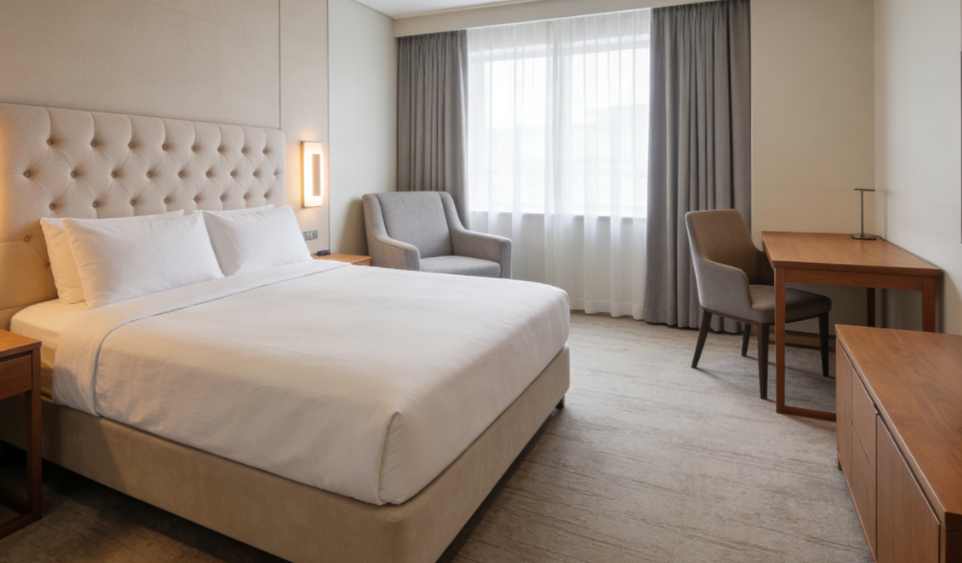
I. How to Balance Fire Standards and Durability? Procurement Logic
For bulk procurement, one must never look solely at the lowest price. The procurement logic should be: Safety (Fire Protection) Always > Functionality > Aesthetic Design
1. Mandatory Fire Safety Standards
If you are entering the Chinese market, soft furnishings such as sofas, mattresses, and curtains must comply with the GB 20286-2006 standard. For European and American markets, filling foam must meet British Standard BS5852 or American Standard CA117.
2. How to Assess Hotel Furniture Durability
Prioritize furniture that is more wear-resistant and stain-resistant. Products must withstand common hotel hazards, particularly alcohol spills and cigarette burns.
Additionally, hotel furniture must be structurally sound. For wooden furniture, prioritize mortise and tenon joints. High-frequency use items, such as chairs, should undergo pressure fatigue testing.
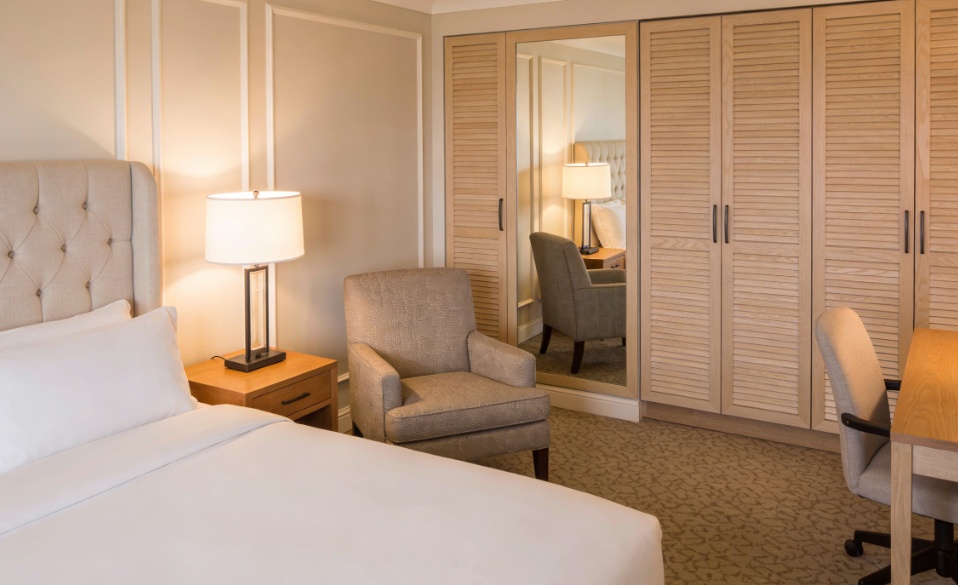
II. Expert Advice: How to Balance Fire Standards and Durability?
Option A: Furniture Using High-Pressure Laminate (HPL) or Nano-Microfiber Leather
Expert Suggestion: Furniture utilizing HPL or nano-microfiber leather offers excellent fire performance. HPL is scratch-resistant and B1 fire-rated, making it ideal for budget and mid-scale hotels.
Regarding flame-retardant fabrics, it is recommended to choose Inherently Flame Retardant (IFR) fibers rather than "topically treated" ones. The former remains wash-resistant and durable, ensuring the furniture does not lose its fire-retardant properties due to frequent professional cleaning.
HPL vs. Nano-Microfiber Leather
| Dimension | High-Pressure Laminate (HPL) | Nano-Microfiber Leather |
| Material Characteristics | Composite of impregnated paper and resin under high pressure | Ultrafine fiber simulating genuine leather structure + nano-coating |
| Fire Rating | Stable B1, carbonizes without flame spread | Customizable to B1, self-extinguishes upon removal of flame |
| Durability | Extremely High. Resistant to scratches, heat, and chemicals | Medium-High. Fold-resistant, wear-resistant, and skin-friendly |
| Best Application | Desktops, luggage racks, TV cabinets (high-impact areas) | Upholstered backrests, headboards, guestroom lounge chairs |
| Maintenance | Difficult to repair locally; requires edge banding protection | Nano-coating enables stain resistance; relatively easy to clean |
Option B: Utilizing High-Density Fire-Retardant MDF as Base Material
Traditional furniture laminates are prone to "edge chipping," which is a subtle fire risk. During procurement, you can require manufacturers to use full-wrap technology or aluminum alloy edge banding to seal off potential paths for fire spread.
III. Three Crucial Details in Hotel Furniture Procurement
1. Beware of Discrepancies Between Lab Reports and Mass Production
Some manufacturers may send high-performance samples for testing but cut corners during mass production, leading to inconsistent fire safety.
Expert Tip: Conduct random on-site sampling and inspections.
2. Beware of Substandard Hardware
Often, furniture fails because of rusted hinges caused by poor-quality hardware.
Expert Suggestion: Specify the use of 304 stainless steel or higher-grade hardware in tender documents. This is especially critical if your hotel is located in a humid coastal area or a tropical/subtropical region.
3. Do Not Sacrifice Maintenance for Short-Term Savings
True high-quality furniture isn't something that never breaks, but something that can be repaired.
Expert Suggestion: Modular designs are better for maintenance. If a nightstand surface is burned, replacing a single panel is far more cost-effective than discarding the entire unit.
IV. Summary
Hotel furniture procurement is a long-term partnership, not a one-off transaction. Therefore, before signing, you must consider more than just the price—you must evaluate whether it offers lower maintenance costs and a sufficiently long lifespan.
V. Hotel Furniture Procurement: FAQ
Q1: What is the actual difference between B1 and Class A fire ratings? How to choose?
A: Class A consists of non-combustible materials (e.g., stone, metal, aluminum honeycomb) that do not burn or produce thick smoke. B1 consists of flame-retardant materials (e.g., treated wood, IFR fabrics) that are difficult to ignite, slow to spread, and self-extinguish quickly once the fire source is removed.
Q2: Why is Inherently Flame Retardant (IFR) fabric more cost-effective than "topically treated" fabric?
A: While IFR fabric has a higher initial purchase cost, it is permanently effective and wash-resistant, resulting in lower total cost of ownership. The maintenance costs of topically treated fabrics will gradually manifest as their performance degrades.
Q3: How can coastal or high-humidity hotels prevent hardware corrosion from ruining furniture?
A: Use 304 stainless steel or hardware (hinges, rails) that has passed a 48-hour salt spray test. Additionally, minimize exposed metal parts and use full-wrap edge banding on panel cuts to prevent moisture from entering and causing deformation.
Q4: Can Modular Furniture truly reduce long-term operating costs?
A: Yes. The surfaces of hotel furniture are most prone to damage, and traditional repairs are complex. Modular designs allow for the individual replacement of damaged panels, armrests, or corners. This reduces "room-down" time for repairs and lowers overall replacement expenses.
About the Author:
Eason, a graduate of Peking University, has been deeply involved in the global furniture supply chain for over 10 years and has spearheaded numerous B2B multinational procurement projects.
More furniture manufacturer lists:
-
How to Wholesale Modern Contemporary Furniture? 7 Ways to Find a Modern Furniture Wholesaler
-
3 Ways to Easily Find Quality Home Decor Wholesale Vendors & Distributors
-
How to Find a Safe and Potential Baby Furniture Supplier? 7 Methods
-
5 steps for restaurant furniture wholesale e-commerce marketing
-
Top 5 Long-Lasting Public Chair Manufacturers with Durable Products in China
-
Top 6 China’s Economical Stainless Steel Furniture Manufacturers and Suppliers at CIFF 2026
-
Top 21 Malaysian Home Furniture Manufacturers: Muar Hub Exporters List
-
How to Identify Furniture Trading Intermediaries? Vet Cross-Border Suppliers from 5 Aspects