
How to Arrange a Safe Home Environment for Seniors with Alzheimer's? (Furniture Edition)
2026-03-21
The common manifestations of Alzheimer’s disease include a gradual decline in memory, as well as impairments in depth perception and spatial orientation. If you have watched the film The Father (2020), you can empathize with the patient’s experience—feeling a confusion of space and time. You think you are looking at reality, but in the next second, it may turn into a memory, leaving you unsure of where you are or who your real relatives are.
Therefore, home design for Alzheimer's patients is crucial. However, many caregivers mistakenly believe that simply keeping the home clean is enough for safety, but professional senior-friendly housing goes far beyond that. For Alzheimer's families, hidden risk details lurk in the corners of the home environment. For example, patients may mistake dark carpets for dangerous pits and hesitate to step forward, or they may be unable to avoid the sharp edges of furniture while walking.

According to research by the Dementia Services Development Centre (DSDC) at the University of Stirling, AD patients' ability to distinguish colors decreases; therefore, high-contrast edge design is not an aesthetic preference, but a survival necessity. Reference: Alzheimer's Society: Making your home dementia friendly (2025 Edition).
In short, whether in furniture procurement or layout, medical experts recommend following these three principles: reduce clutter, enhance cognitive cues, and eliminate fall hazards.
So, how are leading senior furniture manufacturers solving these problems? During our in-depth visits to enterprises in Guangzhou and Foshan over the past two years, we have encountered some successful cases. Some manufacturers reduce the wandering anxiety of the elderly by adjusting the color contrast of furniture, while others optimize and simplify movement paths to reduce the risk of falls.
How to arrange a safe home environment for Alzheimer's patients? Based on our years of investigation and insights from international exhibitions such as CIFF 2026, we have summarized several experiences:
Quick Guide: Dementia-Friendly Furniture Checklist
| Category | Challenge for AD Patients | Professional Recommendation |
| Visual Cues | Depth perception & color blindness | Use high-contrast edges; avoid dark patterns. |
| Stability | Fall risk / Instability | Choose heavy, stable frames; anti-slip bases only. |
| Safety | Collision / Sharp edges | Rounded edges mandatory; use contrasting soft bumpers. |
| Interaction | Confusion / Agitation | Use magnetic/hidden handles; avoid realistic shapes. |
| Support | Difficulty standing up | High armrests; firm, supportive seat cushions. |
| Environment | "Sundowning" / Anxiety | Uniform, shadow-free lighting; motion-sensor night lights. |
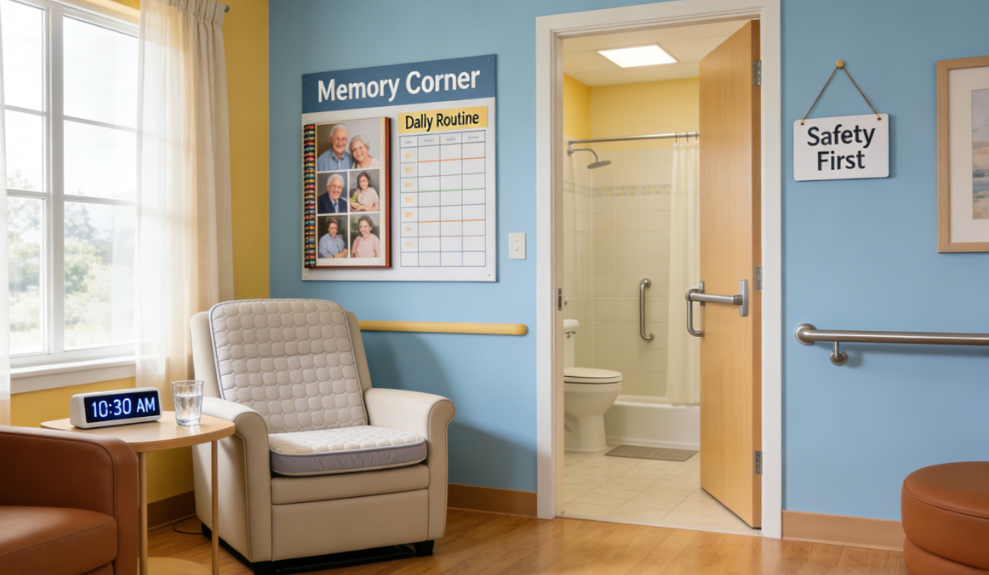
I. How to arrange a safe home environment for Alzheimer's patients? Reducing cognitive load
Most Alzheimer's patients have depth perception impairments and prefer simple environments and furniture layouts. Therefore, the simpler the indoor environment, the easier the cognitive task is for them, and the less likely they are to experience significant anxiety.
Furniture purchased for Alzheimer's patients should have clear visual readability. The color of the furniture should be distinctly different from the floor and walls, making it easier for patients to identify boundaries and reducing the probability of stumbles and falls. Furthermore, try not to choose furniture with overly complex patterns to prevent patients from feeling fearful and hesitant to walk.
By the same token, these elderly patients should avoid using glass coffee tables, transparent dining tables, or full-length mirrors. Patients sometimes find it difficult to distinguish transparent objects or may even think they do not exist, leading to collisions. Reference: Alzheimer's Association: Official Guidelines on "Sundowning" and Home Safety Environment Settings.
II. Key points for senior home safety protection
We found that many patients feel uneasy about dark floor tiles or mirrored surfaces. After replacing them with matte, tone-on-tone furniture, the tense wandering behavior of the elderly significantly decreased.
Compared to other seniors of the same age, Alzheimer's patients hit furniture significantly more often. This is not only because AD patients have a weaker ability to distinguish colors, but also because of errors in distance perception, leading to misjudgments of furniture proximity.
Therefore, furniture must have rounded edge treatments. If furniture with sharp angles is purchased, it must be wrapped with corner protection tools to avoid injury.
In addition, the use of lightweight small furniture is not recommended. AD patients will grab any object in their field of vision when losing their balance. Therefore, all side tables and dining chairs must have sufficient self-weight or base reinforcement and anti-slip bases. Some elderly people have been reinjured precisely because of lightweight plastic chairs or rolling storage cabinets.
Furthermore, cabinet doors should use magnetic suction or hidden switches instead of complex handles. Avoid using handles shaped like fruits or small animals; AD patients may experience hallucinations and mistake them for real objects.
III. Home space layout logic
Alzheimer's patients often get "lost" in their own homes, so they need better visual guidance.
The path from the bedroom to the toilet must be free of any clutter, and furniture placement should leave a wide aisle of at least 100cm to avoid tripping the elderly. Color-contrasting baseboards can be used for this aisle to form a "visual corridor," guiding the senior to their destination. Then, avoid dark floor mats to prevent AD patients from perceiving them as a "deep pit," which might cause them to fear going to the bathroom.
Install handrails by the bed, sofa, and toilet to avoid the risk of falling caused by a sudden rise in blood pressure after standing up quickly. Moreover, handrails should not be the same color as the wall or stainless steel; orange or yellow is the easiest for AD patients to identify. Use anti-slip and warm wood-imitation or silicone materials for handrails to avoid coldness in winter; this sense of warmth can bring a sense of security to the elderly.
Bedside induction ambient lights can be installed, which trigger automatically when the senior gets up at night, providing direction and avoiding the fear brought by darkness. However, there is a detail here: AD patients easily mistake the shadows of furniture for intruders. Therefore, in addition to the bed light, the lighting of the entire space should be as shadow-free as possible.
IV. Emotional care and anxiety management
As a family member of a patient, you can place easily identifiable daily items, such as old photo frames and frequently used cups, on open storage shelves so the senior can see them more easily. You can also put labels on them (such as "for drinking" or "for reading") to reduce the patient's cognitive pressure.
However, note the "less is more" principle: each shelf should only display 3-5 high-frequency items to keep the space "blank." The Dementia Services Development Centre (DSDC) at the University of Stirling has proposed the application of "visual transparency" and "reducing visual noise" in furniture design.
Furthermore, choose chairs with slightly firmer cushions and good support for them. A sofa that is too soft will cause the senior to sink into it, making it impossible to support themselves to stand up. Over time, this easily leads to muscle atrophy, making the elderly feel even more helpless.
For example, choose chairs with high armrests for patients. When the senior tries to get up, they can first grab the armrests to obtain a stable pivot point before exerting force to support themselves. Additionally, many AD patients fear sofas that are too deep or too soft because they feel as if they "sit in and can't get out."
About the Author:
Eason, a graduate of Peking University, has been deeply involved in the global furniture supply chain for over 10 years and has spearheaded numerous B2B multinational procurement projects.
More furniture manufacturer lists:
-
How to Wholesale Modern Contemporary Furniture? 7 Ways to Find a Modern Furniture Wholesaler
-
3 Ways to Easily Find Quality Home Decor Wholesale Vendors & Distributors
-
How to Find a Safe and Potential Baby Furniture Supplier? 7 Methods
-
5 steps for restaurant furniture wholesale e-commerce marketing
-
Top 5 Long-Lasting Public Chair Manufacturers with Durable Products in China
-
Top 6 China’s Economical Stainless Steel Furniture Manufacturers and Suppliers at CIFF 2026
-
Top 21 Malaysian Home Furniture Manufacturers: Muar Hub Exporters List
-
How to Identify Furniture Trading Intermediaries? Vet Cross-Border Suppliers from 5 Aspects