
How Montessori Floor Beds Foster Toddler Independence Through Visual Boundaries
2026-03-26
A toddler's room is their micro-world. Therefore, creating a home environment conducive to growth and purchasing the most suitable furniture is key to shaping their personality.
From the perspective of psychology and Montessori pedagogy, I believe the significance of a floor bed goes far beyond being a mere sleeping tool; it is more like an "accessible micro-world" for little ones.
Some professional children's furniture manufacturers are attempting to eliminate the physical railings of traditional cribs to cultivate independence without compromising safety. My conversations with several Foshan-based factories specializing in Montessori furniture exports have validated my view: more and more designers are removing "guardrails" and instead utilizing tactile differences in materials to define space.
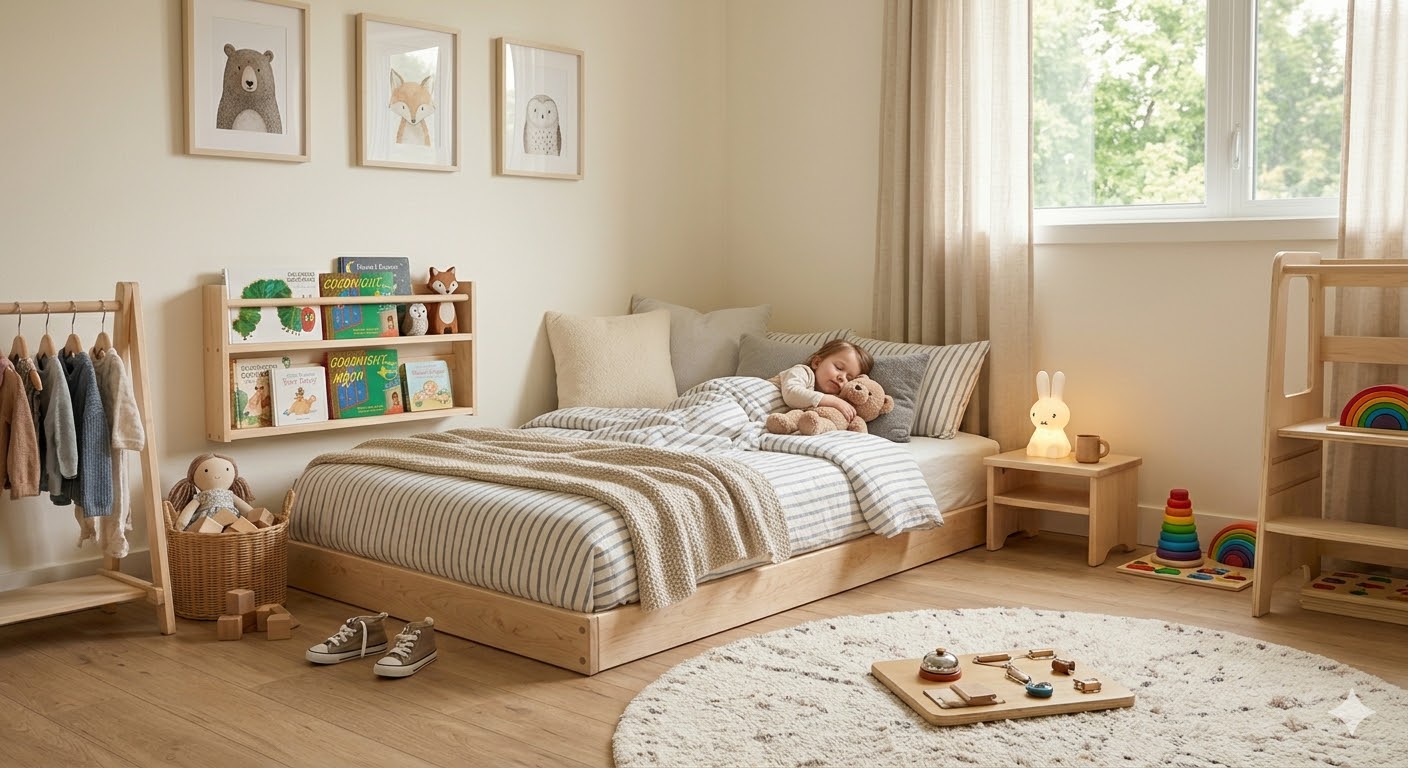
Furthermore, some furniture manufacturers have refined the Montessori floor bed design, cleverly using "visual boundaries" to replace the "sense of physical imprisonment," thereby reshaping a toddler's self-efficacy at a subconscious level.
What is a Montessori Floor Bed?
A "Montessori Floor Bed" is not a single brand of furniture, but rather a category based on the psychology of scientific parenting. It originates from the theories of Maria Montessori (1870–1952).
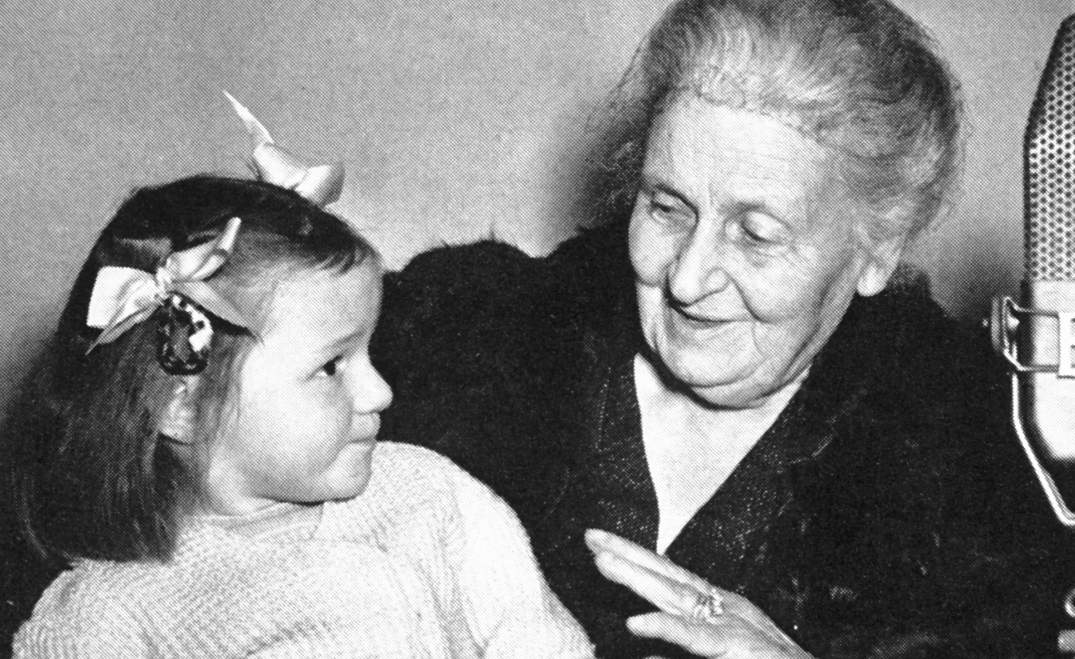
She was the first female Doctor of Medicine in Italian history and a renowned educator and psychologist. She founded the "Montessori Method," which encourages respect for a child’s inherent life potential. The core design logic of the floor bed is to completely eliminate physical barriers and return the power of choice to the child.
"The aim of education is independence, and the most important time for this development is the first years of life." — The Absorbent Mind (1949)
How Montessori Floor Beds Foster Independence: A Deep Psychological Insight
Below is an in-depth psychological analysis of how visual boundaries cultivate a toddler's independent personality:
1. Shifting Identity from "Object" to "Subject"
In psychology, traditional railed cribs create an environment of "entrapment" and "passive dependence," where the infant acts more as an "object." Consequently, the toddler must wait for an adult to pick them up or put them down. This physical restriction fosters the cognition of being a "cared-for object," leading to a lack of subjectivity that can hinder independence in adulthood.
In contrast, the Montessori floor bed emphasizes psychological suggestion through visual boundaries. The low visual edge defines the sleeping area, allowing the toddler to see the entire room at a glance while understanding where the safe boundaries lie.
Science proves this is beneficial for a child's development of subjectivity. When children realize they can decide when to leave the bed, they psychologically become the "initiators of action." This tiny bit of autonomy is the seed of an independent personality.
"When children can exercise autonomous control over their physical environment, the limbic system releases dopamine, strengthening their 'Sense of Agency.' This early experience of successful mastery is a core defense mechanism against future 'learned helplessness.'" — Albert Bandura, Self-Efficacy: The Exercise of Control (1997)
2. Establishing an "Internal Sense of Order"
Overview Table: Montessori Sensitive Periods of Development
| Stage | Core Sensitive Period | Psychological Characteristics |
| 0 - 3 Years | Order, Language, Movement | Building an "Internal Sense of Order"; exploring the world through senses; establishing basic trust. |
| 3 - 6 Years | Sensory Refinement, Social Norms, Writing/Reading | Entering the "Conscious Absorbent Mind"; developing a strong interest in social rules. |
| 6 - 12 Years | Morality, Imagination, Cultural Knowledge | Exploring the "Why"; focusing on justice and fairness; desiring to understand how society works. |
| 12 - 18 Years | Social Justice, Economic Independence, Self-Identity | Seeking social positioning; relating personal value to society; experiencing high emotional volatility. |
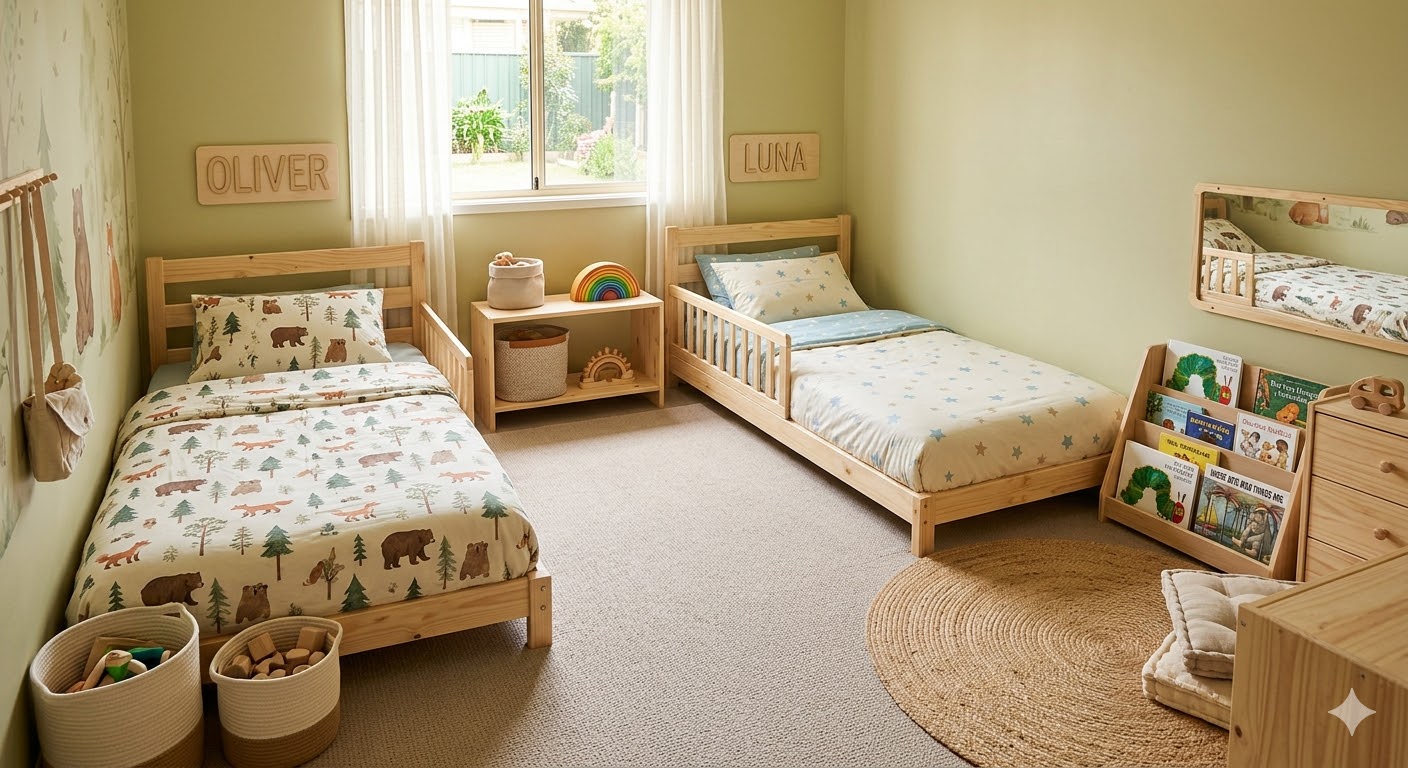
Montessori believed that children aged 0–6 possess an "absorbent mind" that soaks up environmental information unconsciously. Specifically, 0–3 years is the "Sensitive Period for Order." Psychological development during this stage fosters kindness and intelligence. By using visual boundaries with psychological implications, we help toddlers construct a logical map of space in their minds.
On a floor bed, a child’s line of sight is not blocked by railings, allowing them to observe the relative positions of doors, windows, and toy shelves. Achieving this spatial transparency during childhood reduces environmental anxiety.
"Toddlers build cognitive maps in the hippocampus using spatial anchors in their environment. A predictable, visually coherent environment (such as a space without railings) can significantly lower cortisol levels and promote the logical development of the prefrontal cortex." — Adolph, K. E., & Hoch, J. E. (2019)
Furthermore, visual boundaries tell the toddler: "Inside the rug is the rest area; outside is the exploration area." This non-coercive boundary makes the child more autonomous and encourages self-discipline.
3. "Safe Trial and Error"
The floor bed is not without its drawbacks; without guardrails, it is inevitable that a child might "crawl out" in the middle of the night. In psychology, this is known as "safe trial and error." We should never attempt to eliminate 100% of low-risk factors for a child, provided the surrounding area is safe.
The benefit lies in the toddler experiencing the different textures of the floor and the mattress when they roll over the boundary. This immediate feedback helps them truly understand the consequences of their actions, forming a better sense of safety.
"Depriving children of opportunities for low-risk physical challenges during critical developmental periods can lead to an over-reactive amygdala regarding environmental risks. Moderate 'visual-tactile inconsistency' (such as rolling onto the floor) is a necessary stimulus for the nervous system to calibrate balance and proprioception." — Sandseter, E. B. H. (2011)
When they can crawl back to bed on their own, they gain a psychological reward of "I can do it." This sense of competence is the cornerstone of self-esteem.
"The greatest gifts we can give our children are the roots of responsibility and the wings of independence." — Education and Peace (1949)
4. Eliminating the "Cage Effect"
"Learned helplessness" occurs when an individual remains in an inescapable enclosure for a long time, leading to a loss of confidence. For children, being trapped in a traditional crib may decrease their desire to explore, potentially leading to a more submissive or authority-dependent personality.
If a child wakes up and sees inviting educational materials or picture books instead of wooden bars, this visual inducement encourages proactive exploration rather than waiting for instructions.
"Active exploration generates far more functional neural connections than passive reception of information. An open-boundary environment stimulates the brain’s 'curiosity circuits,' which is the physiological basis for a creative personality." — Gopnik, A., The Philosophical Baby (2009)
Psychological Summary & Advice
Children are extremely sensitive to color. When I set up a floor bed for my own child, I used a rug with a color distinctly different from the floor (both being child-friendly colors) to reinforce the impression of the sleeping area. Subsequently, my child developed regular sleep patterns and learned to stay within the bed's bounds.
Additionally, I ensured all furniture in the room remained below my child's eye level to eliminate feelings of oppression and foster stronger self-esteem. If you like, placing a fixed wall lamp on one side of the bed can serve as a "coordinate point" for the child to orient themselves in the space.
About the Author: Julian Guo
Mr. Guo is an author specializing in child development psychology and a graduate of the Department of Child Education at South China Normal University. As a promoter and researcher of the Montessori method, he is dedicated to reshaping children's self-efficacy through the logic of physical space.
More furniture manufacturer lists:
-
How to Wholesale Modern Contemporary Furniture? 7 Ways to Find a Modern Furniture Wholesaler
-
3 Ways to Easily Find Quality Home Decor Wholesale Vendors & Distributors
-
How to Find a Safe and Potential Baby Furniture Supplier? 7 Methods
-
5 steps for restaurant furniture wholesale e-commerce marketing
-
Top 5 Long-Lasting Public Chair Manufacturers with Durable Products in China
-
Top 6 China’s Economical Stainless Steel Furniture Manufacturers and Suppliers at CIFF 2026
-
Top 21 Malaysian Home Furniture Manufacturers: Muar Hub Exporters List
-
How to Identify Furniture Trading Intermediaries? Vet Cross-Border Suppliers from 5 Aspects