
0°-50° Stepless Adjustable Kids' Desk: Do You Really Know Its Hidden Benefits?
2026-03-26
0°-50° Stepless Adjustable Kids' Desk: Do You Really Know Its Hidden Benefits?
When choosing a desk for their children, many parents only consider the height-adjustment feature, overlooking the critical impact of desktop tilt angle on skeletal development and vision.
In reality, conventional flat desks harbor hidden risks that you might not be aware of. Many parents believe that for young children, a flat surface is the most stable. However, physiological structures reveal a different truth: when a desktop is horizontal, children instinctively lean forward to see their books clearly. Research shows that for every 15° the head tilts forward, the pressure on the cervical spine increases by approximately 12 kg [1], significantly raising the probability of myopia and scoliosis in children.
Furthermore, scientific evidence demonstrates that when a book is at a 90° perpendicular angle to a child’s line of sight, eye fatigue is minimized [2]. On a standard horizontal surface, reading often leads to pseudo-myopia. Additionally, flat desks force children to slouch while writing, which compresses the chest cavity and directly impacts cerebral oxygen supply, making it difficult for them to maintain focus during study [3].
Consequently, parenting experts recommend "0°-50° Stepless Adjustable Kids' Desks." Beyond the basics, I will share the lesser-known, hidden benefits of this technology.
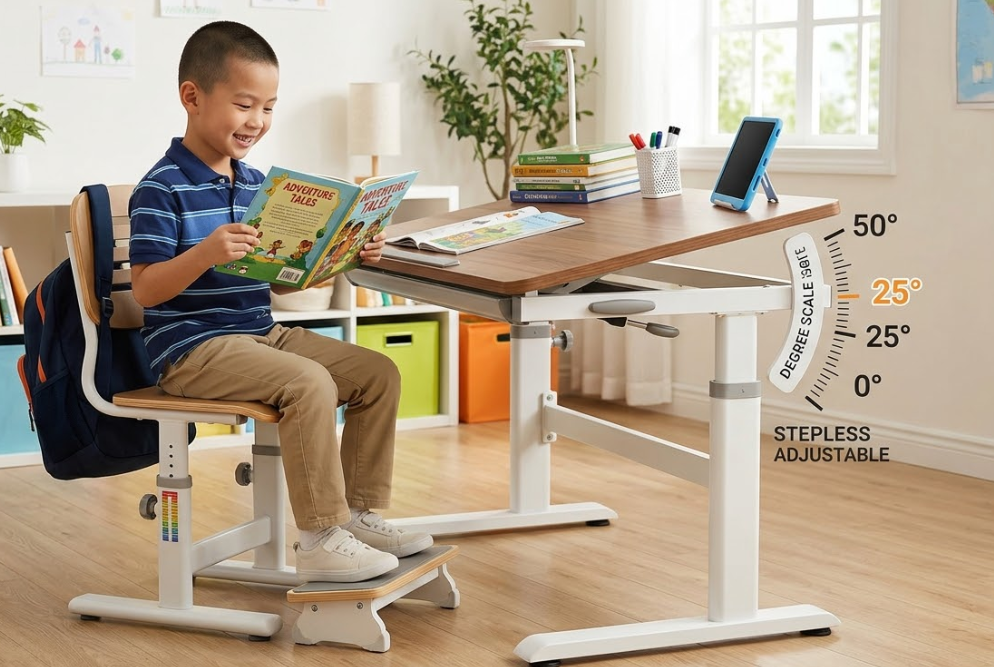
Why is "Stepless Adjustment" superior to "Fixed Positions"?
1. Dynamic Matching for "Full-Scenario" Learning
The 0°-50° range perfectly covers the four core postures of a child's growth:
0°-50° Kids' Learning Scenario Angle Reference Table
| Adjustment Angle | Core Scenario | Postural Advantage | Hidden Benefits |
| 0° - 15° | Calligraphy / Writing | Reduces head tilt | Anti-glare: Changes light incidence to reduce eye strain; relieves 12kg+ of cervical pressure. |
| 15° - 30° | Reading / Recitation | Simulates handheld view | Standardized Distance: Keeps books at 90° to sight, preventing myopia and keeping the chest open for easy breathing. |
| 30° - 50° | Painting / Handcrafts | Upright spine space | Easel-style Immersion: No need to slouch; protects spinal development while creating a focused "creative boundary." |
| 45° - 50° | Online Classes / Video | Eye-level viewing | Zero Neck Burden: Screens are parallel to the line of sight, eliminating the risk of hunching caused by "tech neck." |
2. Solving the Error Between "Height and Perspective"
Every child’s height and arm proportions are unique, meaning a one-size-fits-all flat desk is rarely a perfect fit.
Stepless adjustable desks have no slot limitations, allowing them to adapt to different ages, body proportions, and scenarios. For instance, a child can make millimeter-level adjustments to the tilt based on their fatigue level that day to reach a state of peak comfort. This is something a fixed 3-gear or 5-gear desk simply cannot provide. It is like buying clothes: fixed-gear desks are "Off-the-Rack" (S/M/L), while a stepless desktop is "Bespoke Tailoring" for your child.
I once observed my child coming home from school clearly exhausted after a full day of classes. On a 3-gear desk, the "reading mode" is usually fixed at 15°. Due to his fatigue, my child would have had to slouch even further to accommodate that angle. With the stepless desk, he simply pushed the surface to 18.5°, precisely compensating for the postural collapse caused by his tiredness.
Kids' Desk: Fixed Gears vs. Stepless Adjustment
| Comparison Dimension | Fixed Gears (3-5 Levels) | Stepless Adjustment (0°-50°) |
| Adaptability | Mechanical; limited to specific heights | Millimeter-level fit; ignores proportion differences |
| Personalization | Child adapts to desk (causes fatigue) | Desk adapts to child (reaches comfort point) |
| Scenario Switching | Rigid; restricted by slots | Fluid transition for all needs |
| Long-term Value | Gaps in comfort during growth spurts | Full life-cycle companionship; dynamic growth |
3. Positive Psychological Hints for Learning
The 0°-50° stepless desk also provides positive psychological cues for learning—a benefit rarely mentioned.
Suppose a desktop is tilted to 40° for drawing; it creates a sense of "enclosure" for the child. This physical change provides a positive psychological hint: "I am now switching to creative mode," allowing "Flow" state to be achieved more quickly [4].
I also discovered other psychological benefits. When I adjusted the desk to 20° for my 12-year-old, the book stood "upright" before him. This "standing" position suggests: "This is no longer a heavy chore, but an equal dialogue." Elevating the visual height reduces the pressure of looking down and signals that this is a formal ritual for acquiring knowledge.
Conversely, when my child finishes reading and prepares to rest, manually resetting the desk to 0° acts as a cue: "It is now time for review; everything is under control." The act of flattening the desk serves as a "terminal signal" for that stage of work. I found that this helped my child become more organized and follow through with tasks from start to finish [5].
III. Why Are These Benefits "Unknown"?
Higher Manufacturing Costs:
Achieving stable, stepless adjustment requires high-quality gas springs or hydraulic dampers. The cost makes them less common than standard desks, though modern parents are increasingly willing to invest in scientific health.
Consumer Awareness Lag:
Most parents look for "large bookshelves" or "plenty of drawers," ignoring the "Ergonomic Dynamic Interaction" that is vital for healthy bone development.
Misconception of Difficulty:
Older tilting desks were cumbersome, leaving a "troublesome" impression. Modern systems feature soft-close damping technology, though this experience is best felt through personal trial.
About the Author: Julian Guo
Mr. Guo is an author specializing in child development psychology and a graduate of the Department of Child Education at South China Normal University. As a promoter and researcher of the Montessori method, he is dedicated to reshaping children's self-efficacy through the logic of physical space.
References
-
[1] Kapandji, A. I. (2007). The Physiology of the Joints. (Explaining the biomechanical relationship between head tilt and increased cervical pressure).
-
[2] Journal of Chinese Ophthalmology and Vision Science: (Demonstrating that perpendicularity between book and sight minimizes defocus and relieves eye strain).
-
[3] Chinese Journal of School Health: Research on Hygienic Standards for School Desks and Chairs (GB/T 3976). (Analyzing the impact of posture on lung capacity and oxygen supply).
-
[4] Csikszentmihalyi, M. (1990). Flow: The Psychology of Optimal Experience. (Demonstrating how physical environmental boundaries facilitate "Flow").
-
[5] Barker, R. G. (1968). Ecological Psychology. (Proposing the theory of physical settings as "behavioral settings" that guide psychological state transitions).
More furniture manufacturer lists:
-
How to Wholesale Modern Contemporary Furniture? 7 Ways to Find a Modern Furniture Wholesaler
-
3 Ways to Easily Find Quality Home Decor Wholesale Vendors & Distributors
-
How to Find a Safe and Potential Baby Furniture Supplier? 7 Methods
-
5 steps for restaurant furniture wholesale e-commerce marketing
-
Top 5 Long-Lasting Public Chair Manufacturers with Durable Products in China
-
Top 6 China’s Economical Stainless Steel Furniture Manufacturers and Suppliers at CIFF 2026
-
Top 21 Malaysian Home Furniture Manufacturers: Muar Hub Exporters List
-
How to Identify Furniture Trading Intermediaries? Vet Cross-Border Suppliers from 5 Aspects