
2027 Airport Lounge furniture Design Trends: Integrating Lounges into Daily Living Spaces
2026-05-25
Airport lounges have long been perceived as nothing more than temporary rest stops for travelers, a stereotype that is now gradually fading away.
Driven by the growth of social media and fierce competition among commercial airlines, leading international airports are transforming their lounges into extensions of passengers’ everyday living environments. This shift delivers delightful travel experiences, effectively relieves journey fatigue and helps generate more positive reviews across social platforms.
These changes are backed by solid industry data. According to the latest forecast jointly released by ACI World and Collins Aerospace, every 1% rise in passenger satisfaction with airport facilities translates to a 1.5% to 2% average growth in non-aeronautical revenue, including catering, retail and spa services [1].
Meanwhile, McKinsey’s 2024 travel industry report indicates that nearly half of business travelers regard airport-related stress as the top factor undermining their work productivity during trips [2].
As an experienced spatial designer specializing in aviation interior design, I believe innovative lounge design can greatly enrich travelers’ overall experience. Below are four core design trends projected for airport lounges in 2027.
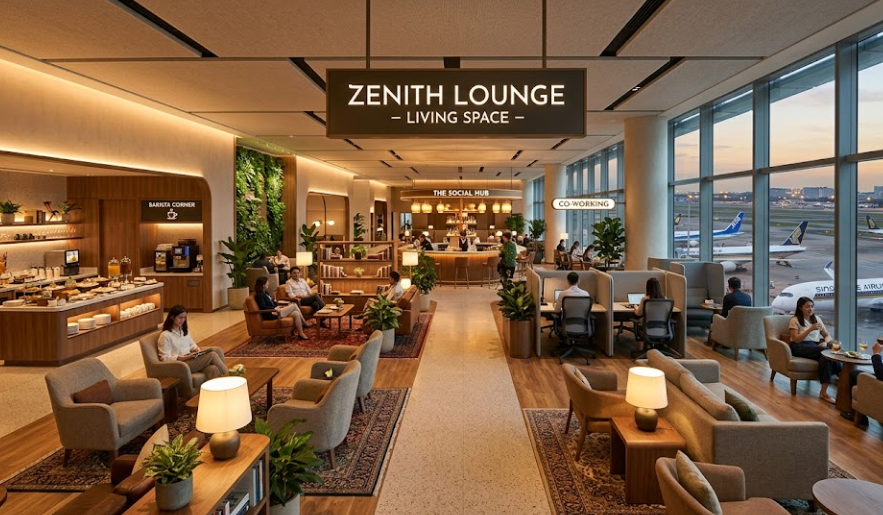
1. Warm Residential-Style Atmosphere
2027 design will embrace a de-commercialized aesthetic. Travelers will no longer feel detached from their surroundings inside airport facilities. Ditching cold rigid seating and glossy polished flooring while adopting residential-grade soft furnishings creates a profoundly relaxing ambiance for guests.
Ty Osbaugh, Aviation Practice Leader at Gensler who oversaw the redesign of New York JFK Terminal 1 and San Diego International Airport, commented, “Leisure travelers now outnumber business passengers and tend to stay longer at airports. We need to reinvent lounge spaces and offer diverse experiences comparable to boutique hotels. Certain zones will function as quiet home studies, while others serve as lively social hubs styled like casual bistros.” [3]
Designers will widely apply materials such as Soundcore® PET wool felt, natural wood veneer and textured woven fabrics. These premium furniture materials not only elevate visual appeal but also absorb ambient noise and build a serene indoor atmosphere.
Designer’s Note: In 2027, designers will leverage recycled PET fiber wall panels and noise-reducing furniture to craft tranquil retreats. Even amid heavy foot traffic inside terminals, passengers can enjoy private, peaceful conversations just like at home.
Uniform plain downlights will be replaced with layered warm lighting ranging from 2700K to 3000K. Floor lamps, table lamps and concealed light strips mimic natural indoor lighting found in residential living rooms, easing travelers’ restlessness and anxiety while waiting for flights.
2. Space Optimized for Digital Nomads
With the rising prevalence of digital nomadism, accessible charging ports have become the most basic design standard for modern airport lounges. Recent spatial efficiency research shows that 43% of premium travelers downgrade airline service ratings due to the lack of dedicated distraction-free work zones [4].
Many lounges are moving beyond fully open layouts and installing enclosed private pods equipped with smart control systems. Passengers can reserve these pods in advance for video conferences or short rests. The overall lounge space is divided into coffee bar areas, social zones and quiet chambers. Such zoning ensures working guests and resting travelers stay undisturbed, maximizing space utilization efficiency.
3. Immersive Nature-Infused Design
Biophilic elements will no longer serve merely decorative purposes but become core design concepts in upcoming interior projects. The founder of BOIFFILS Architectures, renowned for Singapore Changi Airport Terminal 2 expansion design, stated in an interview, “We aim to make architecture a source of emotional comfort. By simulating natural terrains, mineral textures, ponds and flowing streams, we blur the boundary between buildings and landscapes. This seamless natural integration alleviates anxiety caused by disorientation inside transit hubs.” [5]
Designers will combine 3D digital water features inspired by Changi Airport’s Wonderfall installation with living plant walls to create immersive indoor natural scenery. Future design will also engage tactile and olfactory senses, with custom forest-scented fragrance diffused throughout the space and authentic field-recorded natural ambient sounds played via professional audio systems.
4. Social and Local Cultural Integration
Airport lounges stand as cultural icons representing cities and even entire nations. A chief strategist at Chase Design Group noted in an interview, “Modern travelers no longer simply pass through a destination; they crave authentic local cultural immersion. Future lounges will act as miniature cultural showcases, with design centered on building a strong sense of place.” [6]
Reference List:
[1] ACI World & Collins Aerospace. The Evolution of Airport Passenger Experience Report (2024-2025). Analysis on the positive correlation between passenger satisfaction and non-aeronautical income growth.
[2] McKinsey & Company. The State of Travel 2024. In-depth research on psychological stressors and productivity impacts on business travelers inside airport terminals.
[3] Gensler Design Institute. 2025-2026 Aviation Design Forecast & Trends. Interview with Ty Osbaugh published by Fast Company, covering the transformation of airport spaces into boutique hotel-style venues.
[4] Gensler Research Institute. Global Workplace Survey (Aviation Segment) 2026. Statistical data on digital nomads’ demand for private workspaces at transportation hubs.
[5] Boiffils Architectures. Dreamscape & Wonderfall Design for Changi T2. Published in Wallpaper and Interior Design (2024–2025), exploring anxiety relief effects brought by biophilic design.
[6] Chase Design Group Perspectives. Cultural Branding in Transit Hubs. Research on translating regional cultural characteristics into visual and sensory lounge design.