
How to Evaluate Blow-Molded Folding Table Quality in Bulk for Large Exhibition Procurement
2026-07-17
For large-scale exhibition procurement, blow-molded folding tables are always the top choice due to their lightweight build, outstanding durability, and cost-effectiveness. However, bulk purchases often face the critical risk of inconsistent quality.Defective tables that sag, crack, or develop rust after short-term use can lead to substantial economic losses and operational disruptions.
Therefore, mastering professional bulk quality evaluation methods and properly vetting folding table manufacturers is essential for exhibition and commercial procurement. For procurement professionals attending major global sourcing events like the CIFF fair, evaluating physical samples in person using strict criteria is highly recommended.
Rigorous quality assessment for bulk orders cannot rely solely on visual inspection. Buyers must conduct multi-dimensional screening based on material composition, structural craftsmanship, and technical specifications. Below is a complete professional bulk evaluation guide:

1. Material Evaluation: Blow-Molded Tabletop
Material Composition
Qualified blow-molded folding tables must adopt virgin High-Density Polyethylene (HDPE). Pure virgin HDPE features a clean milky white or light gray appearance, delivering excellent toughness with strong resistance to yellowing and embrittlement over time.
Low-Quality Risks: Low-cost manufacturers often mix recycled plastic materials to cut costs, resulting in unstable quality and potential safety hazards. Dark, dull, or speckled tabletops, along with pungent plastic odors, indicate a high proportion of recycled materials.To mitigate this, working with a reputable, verified table supplier that guarantees 100% virgin HDPE is critical. Dark, dull, or speckled tabletops, along with pungent plastic odors, indicate a high proportion of recycled materials.
Tabletop Thickness & Weight
For the standard 6ft (1.8m) commercial folding table, premium tabletops require a thickness of 4.0cm to 4.5cm. Under identical specifications, heavier table units signify thicker plastic walls and solid construction, minimizing the risk of material cutting corners.
Rear Honeycomb Structure
Inspect the density of concave blow-molded grooves on the table’s backside. High-quality manufacturers design dense, evenly distributed honeycomb grooves. This structural reinforcement effectively prevents tabletop sagging under heavy loads and enhances overall structural stability.
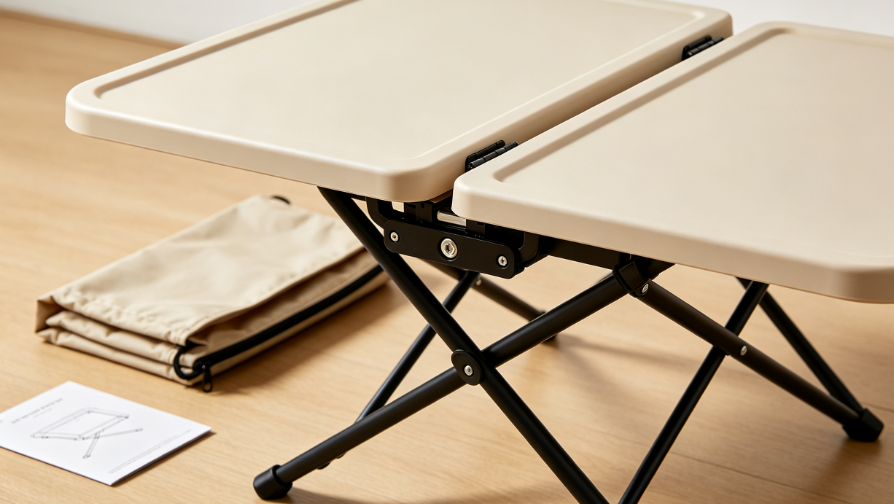
2. Frame & Hardware Evaluation: Steel Pipe & Coating Craftsmanship
Pipe Diameter & Wall Thickness (Core Load-Bearing Indicator)
After sample delivery, use a vernier caliper to measure the steel leg specifications directly. Steel pipes with a wall thickness of merely 0.7mm to 0.8mm are prone to bending and cracking under regular load pressure.
Anti-Rust Surface Treatment (Powder Coating vs. Regular Paint)
Exhibition equipment is frequently exposed to volatile outdoor weather conditions. The metal frame must adopt high-temperature environmental powder coating, which delivers a subtle textured finish. Additionally, the inner steel pipe walls require anti-rust treatment, with zero missing welds or excessive welding slag at all joints.
Automatic Safety Locking Mechanism (Pinch & Sag Prevention)
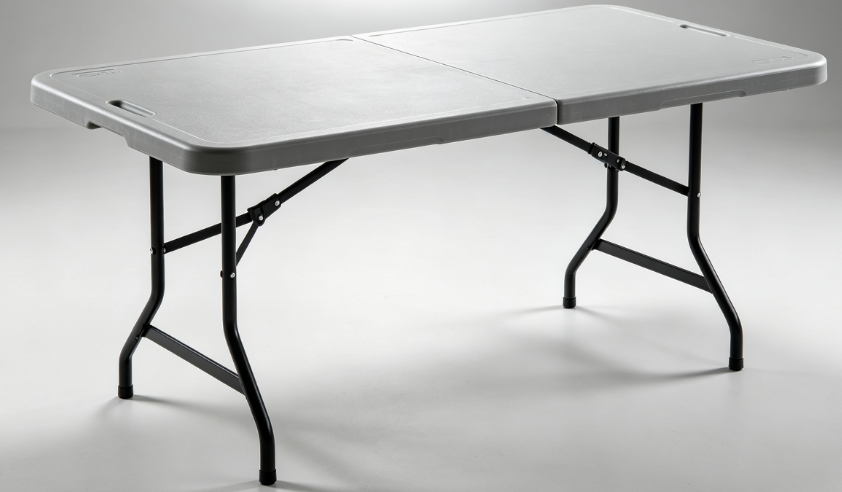
Premium folding tables are equipped with a red automatic sliding locking ring at the bracket joints when fully unfolded, effectively preventing accidental hand pinching and structural collapse during use.
3. On-Site Sampling & Testing Standards
Conduct the following three professional field tests on incoming samples to verify overall quality compliance:
|
Test Item |
Simple Test Method |
Qualification Standard |
|
Local Compression Resistance Test |
An adult weighing 60–70kg presses hard on the exact center of the tabletop with an elbow. |
Slight elastic deformation is acceptable. Permanent indentation and plastic cracking sounds are strictly prohibited. |
|
Overall Static Load Capacity |
Place uniform heavy loads (water crate stacks or equipment) evenly across the 1.8m tabletop. |
Commercial-grade tables must support a static load of 150kg–250kg with no noticeable shaking or bending.These heavy-duty load benchmarks are also closely aligned with the durability codes required for school furniture china, where intense daily wear is expected. |
|
Stability Test |
Grip both sides of the fully expanded table and shake it forward, backward, left, and right with moderate force. |
Minimal loose movement at table leg and tabletop joints. Equipped with anti-slip, wear-resistant rubber feet that protect floors from scratches. |
4. Bulk Procurement Guidelines: Qualification & Packaging Assessment
International Commercial Certification Standards
For bulk negotiations, verify whether the manufacturer complies with authoritative industry standards: ANSI/BIFMA X5.5 (U.S. commercial table safety standard) and EN 581 (EU outdoor furniture safety standard). Priority should be given to suppliers with third-party certification reports from SGS or TUV.
Professional Industrial Cluster Verification
China’s blow-molded furniture manufacturing industry is highly concentrated. Mature export-oriented factories are primarily located in Linhai (Taizhou), Changzhou, and Xiamen. Sourcing directly from an established global furniture factory china hub ensures that manufacturers specialize in long-term exports to European and American commercial markets with stable quality control systems.
Transportation Loss Prevention
Blow-molded tables feature large dimensions and sharp edges. Clear packaging specifications must be confirmed for bulk orders. Require multi-layer corrugated carton packaging with full foam corner protection to avoid damage during international shipping and handling.
FAQs for Blow-Molded Folding Table Bulk Procurement
Q1: What is a blow-molded folding table, and how does it differ from injection-molded folding tables?
A: Blow molding inflates molten plastic inside a hollow mold to form a double-layer hollow tabletop with integrated honeycomb reinforcing ribs. In contrast, injection molding produces a single solid plastic layer. Although injection-molded tables have higher density, they are heavier and prone to warping on large flat surfaces.
Q2: Why do some blow-molded tables sag or turn yellow after long-term use?
A: Table sagging is caused by insufficient HDPE material dosage, thin wall thickness, or poorly designed internal reinforcing ribs, a common cost-cutting tactic from low-end manufacturers. Yellowing and embrittlement result from the absence of UV and anti-aging additives. High-quality blow-molded tables remain crack-resistant and stable even after 5 years of continuous outdoor sun exposure.
Q3: What is the difference between HDPE and PP tabletop materials? Which is better for procurement?
A:HDPE (High-Density Polyethylene) is the premium mainstream option, featuring exceptional toughness, low-temperature resistance, and lightweight properties. PP (Polypropylene) offers slightly higher hardness but poor low-temperature durability and accelerated aging in outdoor environments. Procurement Recommendation: Specify HDPE material for all commercial events, rental services, and outdoor activities.
Q4: What international certification standards apply to blow-molded folding tables?
A:North American Standards: ANSI/BIFMA X5.5 for commercial and office table performance testing. European Standards: EN 12521 and EN 581, covering mechanical safety requirements for outdoor leisure furniture. Environmental Compliance: SGS REACH and RoHS certifications to ensure zero heavy metals and harmful phthalates.
Q5: Where are China’s core blow-molded furniture industrial clusters? How to select reliable suppliers?
A: China’s professional blow-molded furniture supply chain is concentrated in Linhai/Taizhou (Zhejiang), Changzhou/Suzhou (Jiangsu), and Foshan/Shunde (Guangdong). .Certified furniture manufacturers in these regions have mature production lines, stable quality control, and rich export experience for bulk commercial orders.
Q6: What are standard folding table sizes? How to optimize container loading capacity for bulk orders?
A: The most popular commercial specifications are measured in feet: 4ft (1.2m), 6ft (1.8m, best-selling), and 8ft (2.4m). Two mainstream designs are available: solid one-piece tables (sturdier but bulkier with higher shipping costs) and fold-in-half tables (with carry handles, halved volume after folding). For large-volume procurement, fold-in-half tables nearly double container loading efficiency and significantly reduce unit ocean freight costs.While predominantly used for events and expos, many commercial dining furniture manufacturers also supply these fold-in-half models for outdoor banquets, catering, and restaurant dining due to their ease of storage.
Q7: How to customize branded blow-molded folding tables via OEM/ODM services?
A:Low-Cost Customization: Emboss brand logos on the tabletop rear mold, attach branded labels on hardware frames, and customize exclusive color packaging boxes. High-End Mold Customization: Cooperate with R&D-capable factories to develop custom blow molds for special textures such as wood grain and marble grain finishes.
References
-
[1] Exhibition Industry Research Center (EIRC) - Commercial Furniture Lifespan and Procurement Loss Mitigation in MICE Sectors.
-
[2] Association of Plastics Manufacturers / Polymer Testing Journal - Comparative Analysis of Recycled vs. Virgin High-Density Polyethylene (HDPE) in Blow-Molding Structural Degradation.
-
[3] AISC (American Institute of Steel Construction) / ASTM A513 - Standard Specification for Electric-Resistance-Welded Carbon and Alloy Steel Mechanical Tubing.
-
[4] ANSI/BIFMA X5.5-2021 - American National Standard For Office and Institutional Furnishings - Desk and Table Products.
-
[5] EN 581-1 / EN 581-3:2017 - Outdoor furniture — Seating and tables for camping, domestic and contract use.
-
[6] China National Light Industry Council (CNLIC) - Strategic Analysis and Distribution Layout of Plastic Furniture and Blow-Molding Manufacturing Clusters in Eastern and Southern China.