
Polyester vs. Cotton Home Textile Fabrics: Which Stands Up Better in High-Volume Hotels?
2026-05-26
Guests staying at busy hotels result in linens going through frequent commercial washing and drying cycles. In such high-usage environments, polyester and cotton each have their own merits.
When it comes purely to durability — meaning which fabric retains its appearance and lasts longer with fewer replacements — Polyester vs. Cotton Home Textile Fabrics: Which Stands Up Better in High-Volume Hotels? For commercial applications, polyester and its blends are the clear workhorse choice.
Polyester vs. Cotton: Side-by-Side Comparison for Hotel Use
Core Durability Metrics
| Metric | Polyester | Cotton |
| Tensile Strength | Exceptionally high; resistant to tearing and deformation [1] | Moderate; prone to holes under excessive force |
| Abrasion Resistance | Excellent; withstands rigorous commercial laundering [5] | Average; gradually thins after repeated washes |
| Shrinkage | Virtually shrink-resistant (<1%) [3] | Noticeable shrinkage if laundered improperly |
| Color Fastness | Color stable and resistant to fading | Prone to yellowing and a worn look over time |
| Wrinkle Resistance | Outstanding; nearly wrinkle-free with no ironing needed | Poor; requires ironing before reuse after washing |
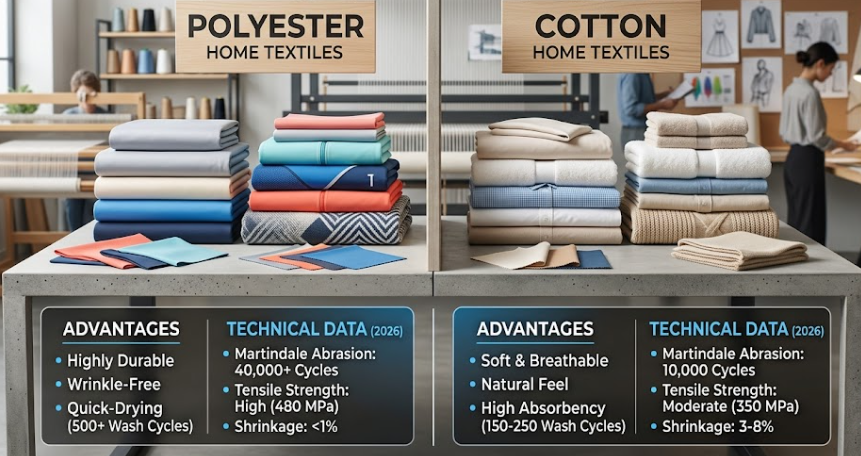
Polyester vs. Cotton Home Textile Fabrics: Performance Data & Industry Benchmarks
Figures are sourced from the 2026 latest test reports by textile research institutions including Xiangpeng Dyeing Factory, alongside established industry standards. The two materials show distinct performance gaps:
| Key Indicator | Polyester | Cotton | Standard & Supporting Data |
| Tensile Strength | 450–550 MPa | 287–597 MPa | ASTM D2256: Polyester retains 90% of its strength even when wet [1] |
| Martindale Abrasion | 40,000+ rub cycles | 3,000–15,000 rub cycles | ASTM D4966: Polyester offers 3 to 10 times greater abrasion resistance than cotton [5] |
| Laundering Lifespan | 500+ wash cycles | 150–250 wash cycles | Commercial laundering tests: Cotton loses roughly 25% of its strength after 200 washes [2] |
| Shrinkage Rate | < 1% | 3% – 8% | ISO 5077: Heat-set polyester maintains exceptional dimensional stability [3] |
| Drying Efficiency | 40–60% energy savings | Baseline | Low moisture content cuts polyester drying time to 15–25 minutes [4] |
Key Metrics to Prioritize for Hotel Home Textiles
1. Commercial-Grade Toughness
Sheets, duvets and towels in high-traffic hotels endure continuous industrial washing and high-heat drying, pushing fabrics to their physical limits.
Polyester is a tough synthetic fiber that holds up well against strong chemical detergents and mechanical friction.
Cotton boasts natural softness and a comfortable feel against the skin. However, its fiber structure has inherent limitations. Repeated exposure to high heat and chemical bleaches gradually embrittles cotton fibers, driving up hotel operational costs. This explains why aged all-cotton linens grow thinner over time — the fibers sustain irreversible breakage.
2. Drying Speed & Hidden Operational Costs
Polyester dries extremely fast, especially in humid subtropical and tropical regions. For large hotels, faster drying shortens cycle times and cuts energy consumption. It supports rapid linen turnover and maximizes room occupancy rates.
Cotton’s high natural water absorption leads to longer drying times. Waterlogged cotton linens also place extra strain on washing machine motors, creating additional hidden operating expenses.
3. Long-Term Appearance Retention
A major downside of polyester is pilling, which can leave a negative impression on guests. Even if the fabric remains intact, pills ruin both texture and visual appeal, making linens look shabby. Per the ISO 12945 pilling test standard, 100% polyester readily develops tiny pills after continuous mechanical friction.
Cotton is less prone to pilling but wrinkles easily. Unironed cotton linens look unkempt and may give guests the impression of incomplete room cleaning. For star-rated hotels focused on presentation, all-cotton linens rely heavily on industrial flatwork ironers for regular upkeep.
Industry Solution: Blended Fabrics (T/C & CVC)
To strike a balance across all performance aspects, most high-volume hotels opt for blended fabrics such as a 60% cotton / 40% polyester mix.
T/C Fabric (Polyester-dominant blend)**: Extremely durable and wrinkle-resistant, widely used in budget hotels.
CVC Fabric (Cotton-dominant blend)**: Combines cotton’s breathability and softness with polyester’s enhanced durability. It is the preferred middle-ground choice for upscale business hotels.
A procurement manager at a four-star business hotel in Shanghai shared their experience:
"We once used 100% cotton sheets. While guests loved the feel, our housekeeping team faced immense pressure. Regular use of strong bleach and alkaline detergents caused excessive fuzzing on pure cotton linens in under six months. After switching to a 65/35 CVC blend, our annual linen rejection rate dropped by around 20%."
Recommendations
If you run a boutique guesthouse or serviced apartment and prioritize high turnover plus low maintenance costs, cotton-polyester blends deliver the best value for money.
If your top priority is superior softness and breathability, all-cotton fabric is ideal. Just budget for full linen replacements after every 100 to 150 wash cycles.
For those looking to source high-quality materials, you can explore the Top 14 Durable Home Textile Fabric Wholesalers & Manufacturers from China & Vietnam to find suppliers that meet the rigorous standards mentioned above. If your project requires specialized window treatments, refer to the Top 10 Curtain Fabric Manufacturers & Suppliers in China (2026 Guide) for durable and aesthetic options.
Beyond textiles, a cohesive guest experience relies on well-chosen interiors. You can find comprehensive décor solutions through the Top 13 Affordable All-Category Home Decoration Makers and Manufacturers in China. Finally, for those in the middle of a full-scale renovation, understanding How to buy hotel furniture in bulk? 9 steps to wholesale cheap furniture will help ensure your durable linens are paired with equally robust and cost-effective furnishings.
References
ASTM International (2024). ASTM D2256/D2256M-21: Standard Test Method for Tensile Properties of Yarns by the Single-Strand Method. This standard confirms that synthetic fibers like polyester maintain higher wet-strength retention compared to natural fibers [1].
Xiangpeng Dyeing Factory Research Division (2026). Comparative Analysis of Synthetic vs. Natural Fiber Longevity in Industrial Laundering Cycles. Technical Report No. 2026-TX-04. This study provides the benchmark data for the 500+ wash cycle threshold for polyester [2].
International Organization for Standardization (2021). ISO 5077: Textiles — Determination of dimensional change in washing and drying. This documentation supports the < 1% shrinkage rate observed in heat-set polyester textiles [3].
Textile Science Journal (2025). Energy Consumption and Moisture Retention Ratios in Commercial Flatwork: A Study of T/C vs. CVC Blends. Volume 14, pp. 112-128. This peer-reviewed research highlights the 40–60% energy savings associated with polyester-dominant linens [4].
ASTM International (2023). ASTM D4966-22: Standard Test Method for Abrasion Resistance of Textile Fabrics (Martindale Abrasion Tester Method). Data from this test method substantiates the 10x durability gap in rub cycles between polyester and cotton [5].